
 About the society
Hyperbaric oxygen therapy
Breathing pure oxygen in a pressurised chamber, to deliver far more oxygen to the body than breathing at normal pressure can.
- Like diving to
- 14 m
- O₂ in plasma
- 5.4 mL/dL
- Versus breathing air
- 17×
Breathing pure oxygen, for healthy lungs. Treatments usually run at 2 to 2.8 ATA.
At this pressure, plasma alone carries roughly as much oxygen as resting tissues use, even without help from red blood cells.
Hyperbaric medicine is an area of medicine which studies the implications of the human body’s exposure to increased barometric pressure. The physiological changes and illnesses which may occur as a result of these changes and the treatment of these illnesses are covered by a practitioner of hyperbaric medicine. The term hyperbaric is self explanatory: hyper donates high and baric denoting pressure. The practice of “Hyperbaric Medicine” covers three broad areas:
- Clinical Hyperbaric Oxygen Therapy: Hyperbaric oxygen therapy is a form of treatment in which a patient breathes 100% oxygen while inside a special treatment chamber where the ambient pressure is higher than normal atmospheric pressure. This is useful for the treatment of medical illnesses such as gas gangrene, traumatic ischemia, and diabetic wound and many others
- Diving Medicine: An occupational part of hyperbaric Medicine wherein they provide medical support (prevention and treatment of diving illnesses) to recreational and professional diving and related activities which expose healthy workers to high barometric pressures under water
- Compressed air works: Also an occupational health component of hyperbaric medicine by providing technical and medical support to operations involving work under high atmospheric pressure like underground mining, metro-rail projects, deep sea mining etc.
While a Hyperbaric Medicine specialist is trained in all the above areas he could be practicing any or all the above during his years and will be expected to provide expertise in all areas.
- WHAT IS HYPERBARIC OXYGEN THERAPY ?
- HOW DOES IT WORK ?
- WHY IS OXYGEN IMPORTANT ?
- HOW IS HYPERBARIC OXYGEN THERAPY ADMINISTERED ?
- ARE THERE ANY NEGATIVE AFTER EFFECTS ?
- WHAT ARE SOME PREPARATIONS BEFORE HBO THERAPY ?
- WHAT IS A MONOPLACE CHAMBER ?
- WHAT IS A MULTIPLE CHAMBER ?
- WHAT IS A SOFT SIDE OR INFLATABLE CHAMBER ?
- DO I NEED A PRESCRIPTION FOR HBOT ?
- "IF HYPERBARIC OXYGEN THERAPY IS SO GOOD , WHY IS IT NOT MORE WIDELY ACCEPTED ?
Basic introduction
"Hyper" means increased and "baric" relates to pressure. Hyperbaric oxygen therapy (HBOT) refers to intermittent treatment of the patient with 100-percent oxygen at greater than normal atmospheric pressures. Hyperbaric Oxygen Therapy is defined as “A mode of medical treatment in which the patient is entirely enclosed in a pressure chamber and breathes 100% Oxygen at a pressure greater than 1.4 atmosphere absolute (ATA)*? These "treatment chambers?can deliver oxygen concentrations to tissues at levels higher than any existing Oxygen delivery methods. *(UHMS committee report 2003) Please note that breathing 100% oxygen at 1 ATA or exposing isolated parts of body to 100% oxygen under pressure or treating a patient at or below 1.4 ATA, does not constitute HBOT.
What is hyperbaric oxygen therapy?
Hyperbaric oxygen therapy (HBOT) is a medical treatment during which the entire body is placed in an airtight chamber at increased atmospheric pressure where the patient is surrounded by air and breathes 100 percent pure oxygen. This treatment is proven effective for a number of different medical and surgical conditions either as a primary or adjunctive treatment. It is also used to treat many other medical conditions that are still considered experimental by the mainstream medical establishment’despite decades of reported benefit
How does it work?
The earth's atmosphere normally exerts 14.7 pounds per square inch of pressure at sea level. That is equivalent to one atmosphere absolute (abbreviated as 1 ATA). In this atmosphere we breathe approximately 20 percent oxygen and 80 percent nitrogen. During HBOT, the pressure is increased by two to three times the normal and the patient breathes 100 percent oxygen.
Why is oxygen important?
Every day an average adult consumes 4 pounds of food, 2 pounds of water and almost 6 pounds of oxygen. People need about the same amount of oxygen by weight compared to food and water combined! From that 6 pounds of oxygen about 2 pounds gets into the blood for transport to tissue cells. We need this oxygen for the energy cycle that sustains life. Oxygen is an essential ingredient of life, maintaining quality, helping the immune system while promoting the re-vascularisation of ischemic tissue. Restriction of vital oxygen levels (hypoxia) accelerates degenerative conditions. Most hypoxic tissues require Hyperbaric pressure to achieve a significant increase in oxygen delivery.? When we do not have enough oxygen in our body tissues, a series of events occur, that if not corrected lead to disease conditions, either infection, tissue destruction or both. If there is low oxygen in tissues (hypoxia) there is a short window of opportunity to correct it. An excellent method to correct tissue hypoxia is by using a hyperbaric chamber.
How is hyperbaric oxygen therapy?
Hyperbaric oxygen (HBO) therapy is administered through the use of a monoplace or a multiplace chamber. The monoplace chamber accommodates a single person for each treatment. Our center uses a multiplace chamber, which accommodates up to six people per treatment plus a doctor, nurse, paramedic or other medical technician to assist with patient needs. At our hyperbaric center no patient undergoes treatment without a health care professional in attendance during treatment. 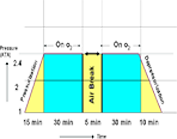 When a patient enters the hyperbaric chamber they sit in a chair for the duration of the treatment. If a patient is unable to sit in a chair then a gurney or bed can be used. When the chamber door is closed, compression takes place with standard air, or the air we normally breathe. It takes 10 to 15 minutes to reach the desired pressure, equivalent to a depth of up to 60 feet of sea water. Once the desired pressure is reached a large, see-through hood or a non-re-breathing face mask is placed over the patient's head and 100 percent oxygen begins to flow into the hood. The patient breathes 100 percent oxygen for the prescribed amount of time, usually 60 to 90 minutes depending on the condition being treated. During treatment the patient can watch TV, read a book or just relax. After the prescribed amount of time has elapsed the flow of 100 percent oxygen is stopped and the hood is removed. The chamber is decompressed, or returned to the same pressure that exists outside the chamber, which takes 10 to 15 minutes. The patient then leaves the treatment environment.
Are there any negative after effects?
Generally patients experience no negative after effects from HBOT. However, some patients report a “cracking?sensation in their ears between treatments as oxygen behind the eardrums is absorbed into the blood stream. This can be relieved in the same manner as clearing the ears during compression and decompression. Also, some patients report feeling light headed for a few minutes immediately following a treatment, but this is brief, and they are quickly able to continue with their normal daily activities such as working or driving. As with all medical procedures and treatments, some potential after effects may result from exposure to hyperbaric oxygen. These are rare and associated with long durations (> 60 days), but will be discussed in detail by the doctor and HBO technician before treatment.
What are some preparations before HBO?
MEDICATIONS:
Some medications are not compatible with hyperbaric oxygen therapy. The HBO technician will obtain a complete drug history before treatment. Each drug taken will be considered individually in relation to HBOT, and should changes be indicated, the prescribing doctor will be advised. Some commonly used medications may potentate side effects from HBOT. They must be limited or substituted with another drug. These include: high doses of aspirin and prednisone (or similar cortisone type drugs), and morphine, or alcohol within 8 hours of treatment. Special precautions also are required for HBOT patients who are taking insulin, pain medication, tranquilizers, high doses of prednisone and other corticosteroids, and anticoagulants. The doctor or nurse will explain any needed precautions. Patients will be instructed to take a regimen of high potency nutritional supplements containing vitamin E and other antioxidants during a course of hyperbaric oxygen therapy.
COLDS AND OTHER SYMPTOMS:
It is important to notify the HBO technician should symptoms occur of a cold or the flu, fever, cough, sore throat, runny nose, cold sore, nausea, vomiting, diarrhea, or a generalized ache-all-over feeling. Those types of illnesses are not helped by oxygen, so the HBO treatments may need to be postponed until symptoms have subsided and the doctor allows resumption of HBOT
SMOKING:
Nicotine is another substance that is not compatible with HBOT. Once HBOT has been prescribed, patients should stop the use of tobacco in any form until therapy is complete. This “no smoking?rule applies to cigarettes, pipe tobacco, and cigars, as well as chewing tobacco and snuff. If a person just cannot stop the use of tobacco, HBOT will not be as effective.
COSMETICS:
Cosmetics, hair spray, nail polish, perfume, or shaving lotion containing petroleum, alcohol or oil base are not allowed while in the HBO chamber. However, those products may be reapplied after each treatment. It is important to discuss all skin care products with the HBO technician so they may assure safety. CLOTHINGS & ARTICLES ALLOWED INSIDE CHAMBER: Patients are provided with 100-percent cotton gowns to wear during treatment. No articles containing nylon or polyester can be worn in the chamber. Watches and other jewellery, dentures, glass contact lenses and other prosthetic devices will also need to be removed before treatment. It is also important that cleanliness be maintained during the course of treatment. No purses, newspapers or glass items are allowed in the chamber. However, reading glasses, contact lenses, magazines, books and cards are allowed. No lighters, hand warmers, CD-players, radios, pocket games, cameras, hearing aids, or other battery-powered devices. Parents often ask what toys and games can be taken into the chamber for their children. Approved toys include most non-metal, plastic toys including plastic legos, soft cotton stuffed toys, books, crayons, plastic markers, and most board games as long as they do not contain metal of any kind. Also, children can take their favorite blanket as long as it is only made from cotton. Wear shoe covers over street shoes or bring a clean pair of rubber-soled shoes or slippers to be worn only in the chamber.
SCHEDULING:
The HBO technician will usually schedule treatments on a daily basis. Every effort will be made to consider personal schedules and other activities of daily living. There may be times when an HBOT appointment must be cancelled or postponed due to emergency situations. If, on the other hand, it is not possible to keep an appointment, the clinic should be notified as soon a possible.
What is a monoplace chamber?
Monoplace chember
A monoplace chamber is designed for one person to go inside. Most monoplace chambers are compressed using 100% oxygen although some are compressed using air and a hood or mask for oxygen. Some monoplace chambers have large acrylic windows while others may have portholes to see out.
What is a multiplace chamber?
Multiplace chember
A multiplace chamber is designed for more than one person to go inside. The oxygen is usually administered using a hood or mask.
What is a soft side?
A monoplace chamber is designed for one person to go inside. Most monoplace chambers are compressed using 100% oxygen although some are compressed using air and a hood or mask for oxygen. Some monoplace chambers have large acrylic windows while others may have portholes to see out.
Do I need a prescription?
In the USA a prescription is required to receive oxygen in a hyperbaric chamber. Oxygen is considered a drug by the FDA and therefore requires a prescription.
If hyperbaric oxygen therapy?
Doctors are rarely taught about hyperbaric oxygen therapy (HBOT) in medical school and therefore most do not know about it. Only about 20 medical schools, less than 15 percent, have actual hyperbaric oxygen facilities, while perhaps another 20 have access to HBOT facilities. If physicians don't know about a therapy, they obviously won't prescribe it. If they don't prescribe HBOT, there is no incentive for more hyperbaric treatment facilities to be established. Therefore, there exist very few hyperbaric chambers, compared with potential need and benefit that could otherwise be achieved’only about 400 chambers in the entire U.S.A. Many of those are dedicated to diving accidents (bends) and are not available for other medical conditions. And, many are located in hospitals that restrict HBOT to a small number of medical conditions reimbursed by Medicare.
Is HBOT right for you?
Talk to the hyperbaric team about your condition.